*Translated by Cris Stenella*
The year 1850 marked a turning point in the history of the arithmometer. Thomas had become a rich man: his insurance companies, "Le Soleil" and l'Aigle, were doing well. Europe was industrializing ! The machine was becoming trustworthy. In short, all the factors were present to insure the commercial success and the shining of our Knight.
On the technical side, the models were succeeding each other at a relatively steady pace. Nearly 500 machines left the workshop between 1850 and 1865. Unfortunately, only few have survived. Today, about 40 machines from this period are known, or in other words, 8% of the production.
This scarcity has made the dating of the machines difficult, and the available knowledge rather haphazard. Too many machines sold at auction have been dated incorrectly – due to the serial numbers!
I) First indications
a) Numbering and chronology
It seems that the numbering, which one would suppose to be chronological, is not in agreement with the technical characteristics of the machines.
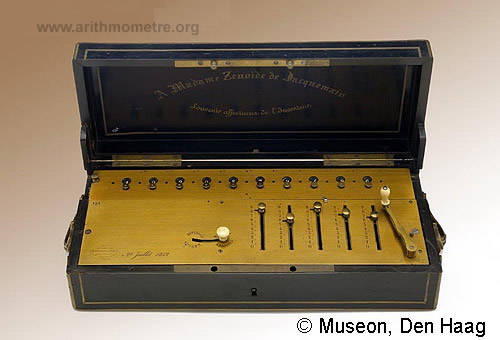
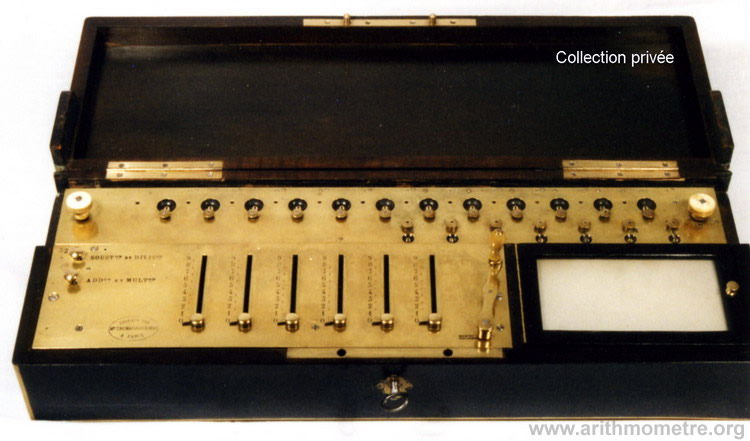
Take for example the machine N° 151, and compare it with N° 52. The former had been offered in July 1852 to Zénoïde de Jacquemain, the niece of Thomas de Colmar. The latter is a model fabricated around 1860. It has been perfectly described in the scientific literature of the age by Franz Reuleaux, L’épervier du Quennon and Hirn
If we follow the hypothesis of cesecutive numbering, we find that N° 52 should have been made in 1851, whereas we know that it was constructed in 1860.
N° 151
Without counter |
N° 52
With counter register |
Juillet 1852 |
1860-... |
|
|
b) Existence of identical numbers
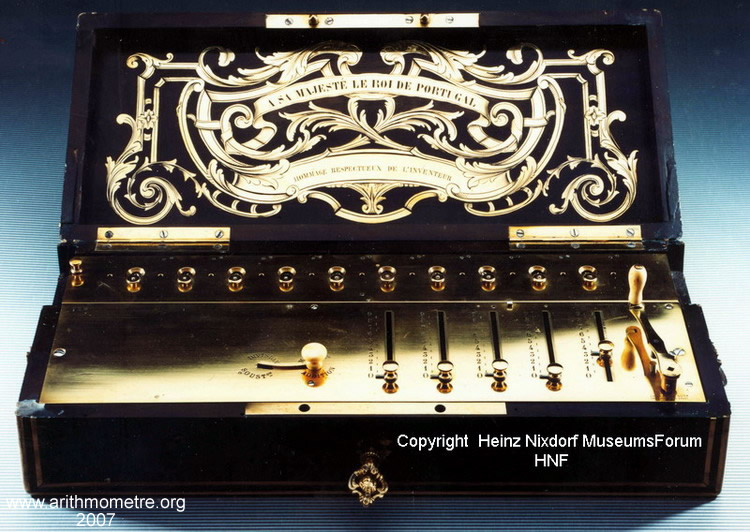
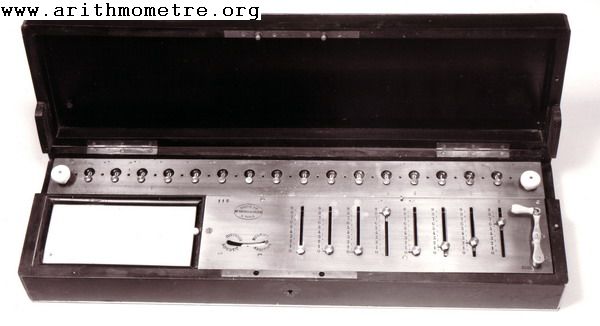
The situation with N° 118 illustrates the case perfectly. Two machines can be found, of the same model (T1852), but with different capacities !
•
The first, with capacity 5x0x10 (A) was offered in 1852 to the king of Portugal.
•
The second, of capacity 8x0x16 (B) dates back to 1854. The exact date is known, because one of its siblings, N° 105, was offered in June 1854 to Mr.
LeVerrier, director of the Imperial Observatory in Paris.
S/n 118 |
S/n 118 |
Machine du roi du Portugal |
© Deutsches Museum |
|
|
1852 1852 |
1854 1854 |
c) The case of N° 4, the lowest serial N° known.
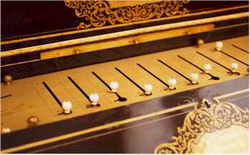
Is N° 4 the oldest ? Not at all! On the technical side, the machine has a more recent carry-over mechanism, designated “horizontal push”. Its principal function is to avoid the carriage being lifted during the carrying phase, and thus disturb the results, as was the case on the T1850 model. To alleviate this inconvenience, an ingenious system of carriage rentention was integrated on T1852. Let’s observe that also the famous “Piano arithmometer” of the Universal Exposition of 1855 has this same mechanism.
These two elements allow us to date back N°4 quite objectively to 1854-1856. For more technical details, you are invited to read “Models and Carrying Systems”.
S/n 4 |
Piano-Arithmomètre de 1855 |
1854-1856 |
1855 |
|
|
d) Is there logic in this madness ?
By reading these few lines, it is clear that the numbering is misleading.
But it is not as if Thomas’ workshop master just did whatever. The data are missing, certainly, but nevertheless, there is a body of evidence, as they would say at the police.
Please permit me to present the hypothesis of the workshop register.
II) The workshop register
In reading an article of the Rev. Moigno, written in January 1854, in the well-known science magazine “Cosmos”, this workshop register hypothesis has sprouted.
In his text, the author states that approximately 200 machines of ten digits (5x0x10) and fifty-something machines of 16 digits (8x0x16) had already left the factory.
If we take the year 1850 as a strating point, the date at which Thomas de Colmar started mass production of his arithmometers, this gives us an average of approximately 50 10-digit machines (A) and about a dozen 16-digit machines (B) per year.
Let’s start with the idea that the workshop manager kept a register in 1850 in which all the manufactured machines were entered. For reasons of counting ease, each version (A and B) would have its own numbering. During the first few years, the smaller machines with 10 digits sold better as they were cheaper. As a result, a growing discrepancy in the numbering was created.
No small wonder then that a 16 digit machine N°118 was manufactured with an identical serial N°2 years after its 10 digit counterpart !
Capacity |
Serial Number |
Year |
5x0x10 |
S/n 118 |
1852 |
8x0x16 |
S/n 118 |
1854 |
In 1852, Thomas modified his arithmometer (T1852) which still exists in two versions (5x0x10 and 8x0x16). He takes out the multiplicator , modifies the direction switch and makes the carryover mechanism more secure. But how to treat this newcomer ? Is it a new model ? Should a new numbering scheme be created ? Or continue the already existing one ?
What is certain is that despite this, at some point numbers started to be engraved on the top plate of the machines. For the 10-digit arithmometer
(T1850A) for example, they steadily rise between N°118 and 190. We are thus very close to the 200 machines mentioned by the Rev. Moigno.
The problem is finally to discover what was the first number to be engraved on the top plate of a 10-digit machine!
Our starting hypothesis really comes into its own here – rather than starting the numbering of the new machine at 1, it was based on the workshop register. If 100 T1850A machines have been constructed, then well, the numbering of T1852A will start at N°101.
At the current state of research, it is difficult to be really precise.
Taking into account that the T1850 were not numbered and that we have no certainty on the starting number of T1852, it would not be impossible that only 50 T1850A have been constructed, against 150 T1852A. For the larger models T1850B and T1852B, the principle is the same, but the quantities are less.
The discovery of new numbers will allow us to refine this transition point further.
Finally, counting the numbers, we arrive at a total of around 300 machines constructed in 5 years. The construction of the piano arithmometer presented at the Paris universal exposition presented the culmination of this period.
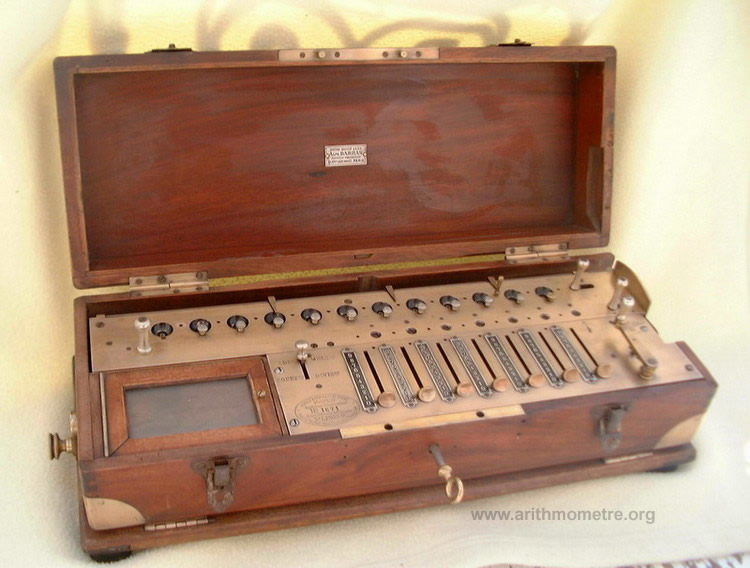
Between 1856 and 1865, Thomas continues to improve his machine. He introduces in 1858 a system of revolution counters for each decimal position (6, 9 or 11 according to the version). This is an important innovation. It permits the operator to check the progress on a multi-digit multiplication, greatly simplifies divisions and the extraction of square and cubic roots. In 1860, the new model T1860, made in two versions, first leaves the workshop. All of them carry serial numbers below 60, which points to a specific numbering scheme for these machines. Later, in 1863, a small “economy” model T1863 extends the model range. It is of small capacity and does not have revolution counters. What is most interesting though, is that the numbering immediately starts at N°500.
No N°200, no N° 300, no N°400!
Let’s not worry – the hypothesis of the workshop register can explain this – before the multiplication of the models, it became urgent to simplify the register. In counting the number of machines sold up to this date since 1850, the number surpassed 400. The idea of restarting at a round number
(500) testifies of a willingness to harmonise. From this moment on, the numbering will be continuous.
In 1865, a new patent is deposited. New machines, a new stamp, but the numbering continues, no matter the version of the machine – small (A), mid-size (B) or large, with 20 digits (C).
Thomas is thus in the possession of an impressive model catalog. The inventory of the workshop at rue de la Tour des Dames 16 in 1870, at the death of Thomas de Colmar, indicates that all these models were in stock.
Designation |
Model |
Number |
Price |
| |
|
|
|
| Machines with 12 digits with regular counter |
T1860 A |
40 |
100 fr. |
| Machines with 16 digits with regular counter |
T1860 B |
33 |
150 fr. |
| Machines with 10 digits without counter (5x0x10) |
T1865 - |
13 |
50 fr. |
| Machines with 12 digits with clearing counter |
T1865 A |
58 |
200 fr. |
| Machines with 16 digits with clearing counter |
T1865 B |
76 |
250 fr. |
| Machines with 20 digits with clearing counter |
T1865 C |
9 |
400 fr. |
III) 1865-1907 : the numbering continues
Between 1865 and 1887, nearly 2000 machines leave the workshops with the Thomas de Colmar stamp. When speaking of the “Thomas de Colmar”
arithmometer, there are those before 1870 (the date of his death) and those after 1870 (This will appeal to the purists).
His son, Thomas de Bojano, will continue the production of arithmometers engraves “Thomas de Colmar” until 1881, then one of his sons takes over the torch until 1887. At the beginning of 1888, the rights were transferred to a celebrated engineer who had already been the contructor of the Thomas arithmometers for several years: Louis Payen.
Indeed, a Thomas machine with N° 1800 was already a machine constructed by Payen! The latter would however not place his own stamp on the machines until 1888. The first Payen models (P1) are completely identical to the last Thomas models. At the dawn of the new century, Payen machines numbered
+/- N°3900 can be found.
IV) 1907-1915: the widow Léontine Payen launches the “Eagle” model.
At the death of Payen, in 1901, his widow Léontine watches the shop. She even deposits a patent in 1907 for a new arithmometer having mainly improvements in the zeroing systems of the counter and result registers.
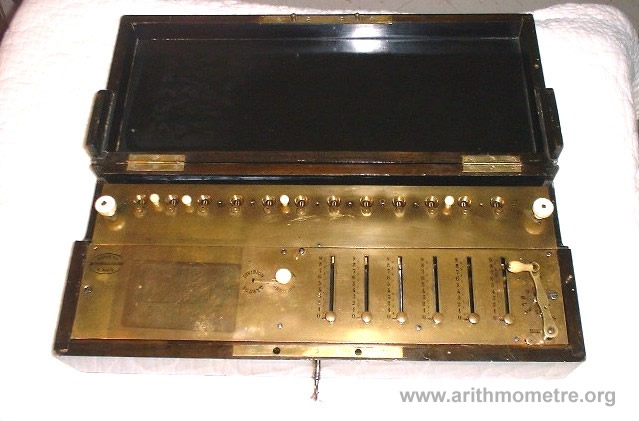
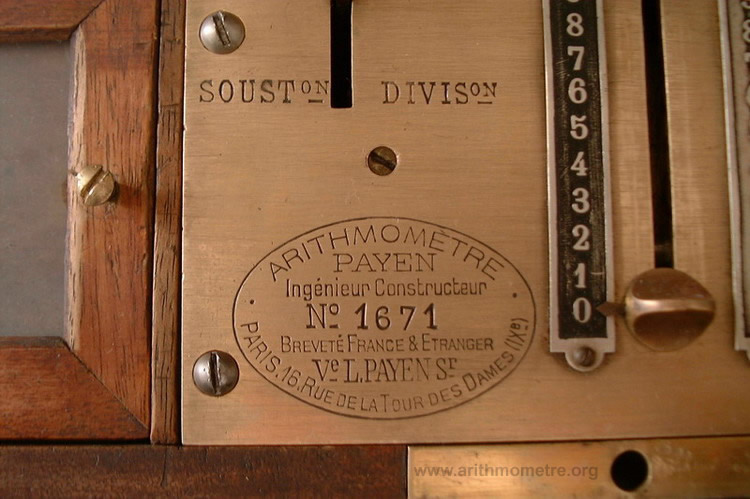
These machines carry the stamp “Vve. L. Payen” superimposed over an eagle with spread wings. Hence the name “Eagle Payen” (P4)
A new numbering scheme is introduced: it seems to start at N°500, then stops around N°1700. Were there really 1200 arithmometers of the type P4 constructed and sold between 1907 and 1914 ? What is strange is that only about 20 machines from this period have been registered until today, a survival rate of less than 2%. That is not much with regard to the 5-8% which is found on average for all other models.
Payen "Eagle" P4 |
Detail of the stamp |
Circa 1914
|
|
|
VI) 1915: Sale of “Veuve Payen” to Alphonse Darras
In March 1915, the widow Payen sells her business to Alphonse Darras, who keeps shop at the Bd. St. Germain 116, in Paris. He is not a new face – He is an old hand of the “Maison Deschiens”, which fabricated the counter registers since the 1870’s. Like Payen fabricated in the beginning arithmometers still engraved “Thomas de Colmar”, Darras has without doubt manufactures machines of the type P4 before he took over the business under his own name. The inventory made on the occasion fo the take-over shows a magnificent picture of the state of manufacture of the Payen arithmometers in the beginning of 1915. It gives information on many aspects. First of all, many machines are in stock. We find around 30 arithmometers P3, new and second-hand, as well as around 40 arithmometers P4 of the last generation. Among them a number still being assembled (N°s 1707 to 1711).
What is interesting, is the numbering of the new machines P4 in stock – There are N°s in the 500 range, a N°1015, then the numbers jump directly to the 1600 range. Taking into account that these are machines in stock, and thus for sale, these holes in the numbering leave us a bit perplexed and remind of the question whether really 1200 machines P4 were manufactured.
In reality, there are probably much much less!!
Let’s return to Alphonse Darras …
1915: a really bad time to make a business flourish. The war machine needs to be fed, and copper is worth it weight in gold. Then there are all the machines in stock to sell. In these troubled times, Alphonse Darras nevertheless manufactures a number of machines (maybe 50) and puts his own monogram (AD) on them. Again, a new numbering scheme is used (N° 5500 to 5550).
Does this choice of starting at N°5500 correspond to the sum of all the Thomas and Payen arithmometers constructed since 1850 ? It is true that when 3900 Thomas and Payen machines are added to the 1700 P4 models, this number is more or less reached.
5500 Thomas and Payen arithmometers constructed ...
I
is this the truth ?
A slightly inflated truth ?
Or a very inflated truth ?
I will leave the reader to be the judge of that!
/VM |