Multiplier & Quotient
One digit systems
Counters
Dial
Cursor
Pointer or Hand
False counters
Pointers counter

Counters

1820
1822-1848-1850
1856
1851
1851
1855-1858-...


* Translation and adaptation by Michel Bardel, France


I) Multiplier/quotient cursor

A) T1822

As soon as 1822, the multiplier is improved. It is true that the 1820 patent shows a fragile and rough mechanism.
Under Devrine management, a new system is developed. The multiplier device becomes linear. In fact it is a cursor that can be moved along a scale numbered from 0 to 9 (multiplier value).
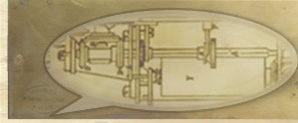
Under the plate, the cursor is linked to a ring, slipping along a square axis. A finger protrudes from this ring and stops a multiplier drum after 1, 2, 3, …,9 tenth of its rotation. The multiplier drum has nine arresting steps the length of witch correspond to 1, 2, 3, …, 9/10th of its circumference.
The multiplier drum turns ten times slower than the stepped drums.  Function of the position of the cursor, the finger will stop the machine after the right number of revolutions.

For instance, when the cursor is set to 8, the operator pulls the ribbon, the stepped drums makes 8 turns, then the 8th step of the multiplier drum comes into contact with the finger and the machine stops.

As properly written by Hoyau : “The section of the mechanism that we have just discribed is somehow independent from the one devoted to calculations ; it drives the machine and sets the number of rotations to be performed by the stepped drums F to complete the desired operation.”  /BSEIN, 1822, page ?


B) T1848 - T1850


In the machine of 1848, built by Piolaine, the multiplier drum now has an helix groove making ten turns around the drum, and intersecting ten times a straight groove along the upper side of the drum (when the machine is in the neutral position). The multiplier drum turns at the same rate as the stepped drums. The cursor, the ring and its finger are placed along the top side of the drum. The finger in engaged into the grooves. Before a multiplication, when the machine is still in the neutral position, the cursor can be moved to the desired multiplier digit, thanks to the straight grove. When the crank is turned, the rotation of the multiplier drum moves the finger along the helix, down the cursor slot, one digit per turn, and stops the rotation when it reaches the zero position after the exact number of turns.


C) T1850


On the T1850 model, the principle stays the same. But a  complementary scale of digits is added, so that the quotient can be read directly. Before the division, the cursor is pushed up to 0 (division scale). When the rotation is stopped by the operator (because the rest is less than the divisor), the quotient digit can be read in front of the cursor, and noted on a sheet of paper.

Soon, this device is disused. T1852 and T1856 models don’t enjoy this device.

So why?

Because the manufacturing cost is too high? Because this kind of stop creates too much strain on the drive mechanism, reducing the reliability of the machine? Thomas used to say that the operator could take care of the number of turns, having no other concern for the rest of the operation.

It is a fact that this “one digit counter” only gives one digit per decimal position.
The cursor has to be reset after each carriage motion. During a division, the operator has to interrupt the process, the time to note each figure on a sheet of paper, unless his memory is reliable enough to remember the whole quotient.

In 1855, the introduction of the counter (Cf Piano-arithmomètre) and its integration, a few years later, on the serial models definitively make the one digit systems obsolete.


* Translation and adaptation by Michel Bardel, France

www.arithmometre.org
2007