* Translation and adaptation by Michel Bardel, France
I) Multiplier/quotient dial (Project 1820)
Leibniz invented the first multiplying machine in mechanical calculation history.
Besides his famous « stepped drums » that can also be found in Hahn’s or Thomas’ machines, he designs a large dial, perforated with ten holes. This dial, used with a stylus, acts as a stop wheel for the multiplication process.
|
Leibniz multiplier/quotient dial
The machine of 1694 |
|
Arithmometre multiplier/quotient dial (1820)
Patent N° 1420
|
II) Description of the multiplier/quotient dial
This mechanism is designed to alleviate the operator task. When he pulls the silk ribbon, he doesn’t have to count the number of revolutions made by the machine.
It is the position of a large stop pin, inserted in one of the dial holes that sets the multiplier value, by stopping the driving mechanism after the matching number of revolutions.
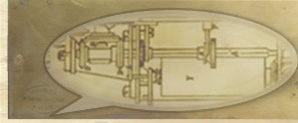
A unique tooth o (fig. D), protrudes from a square axis and turns at the same rate as the stepped drums. Once per revolution, it strikes against one of the ten pins f riveted under the dial and makes it turn one step forward.
On the surface of the dial, a large stop pin g can be inserted in any of the 10 holes drilled around the dial. When pulling the silk ribbon, this pin comes to stop at zero, against the arm h that holds the dial axis (fig. A and B on this page).
Fig. A |
|
Thomas multiplier/quotient dial
In black, the holes for the large stop pin g.
The ten pins f are riveted under the dial.
The arm h stops the large pin after the desired number of revolutions. |
Fig. B |
|
Thomas multiplier/quotient dial
Five of the ten pins are shown here under the dial. They act as gear teeth to rotate the dial. |
Fig. D |
|
Details of mechanism
Each turn, the tooth o pushes one of the pins f, and rotates the dial by one tenth of a turn |
Fig. E |
|
Position of the tooth o
Rotating anticlockwise, as the stepped drums, and at the same rate, the tooth o strikes against one pin f.
Depending on the position of the tooth o on the square axis (near the front plate or near the rear plate : it is not clear in Thomas patent),
the dial will rotate clockwise or anticlockwise. The position of the digits on the dial is to be placed accordingly. |
|