Carry-over system
                 
Type 1
Type 2
Type3
Type 4
Type 5
Type 6
Type 7
Type 8
Type 9
1820
1822
1849
1850-52
1856-58
1860
1865
1880
1887-1907

* Translation by Andries de Man


I) Patent from 1820 (T1820)


The arithmometer of 1820 has probably never existed. Since two years we have tried, with Michel Bardel, to resurrect this mechanical ghost! A detailed study of the patent has enabled us to point out a number of inconsistencies that render the machine inoperable. Where these "errors" made on purpose ? Was Thomas trying to deceive the competition?

The "Arithmometer1820" project was born ! (See ..)


a) Displacement

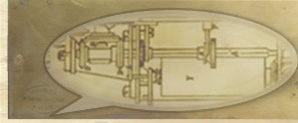
When passing from 9 to 0, the peg t, placed under the result dial, will push away a round shaft r, on which is mounted a yoke q, which will shift the gear p over several millimetres (about 0.5 cm), which causes it to engage with the tens-carry tooth of the stepped drum (10th tooth of the drum). and thereby transfer one unit to the next decimal place.


Cross-section view of the machine


Oblique push
The peg t pushes the shaft r down and escapes sideways


b) Locking (2 options)

The shaft r is spring-loaded, which causes the mechanism to return to its initial position. A ratchet s prevents a premature return, so that the mechanism can complete its task.
The patent does not describe clearly what the exact position of the ratchet is. Does it block the system by locking the yoke q(Option A ) or does the ratchet act on the shaft r itself (Option B ) ?


Position of the ratchets S for option A or B


Locking the yoke q by the ratchet S.


c) Unlocking

At the end of the cycle, the shaft will have to be unlocked and moved back in its initial position. This is done by a little arm v that is attached to the stepped drum and acts on the ratchet s.


More information on the project "Arithmometre 1820"


www.arithmometre.org
2007