Carry-over system
                 
Type 1
Type 2
Type3
Type 4
Type 5
Type 6
Type 7
Type 8
Type 9
1820
1822
1849
1850-52
1856-58
1860
1865
1880
1887-1907

* Translation by Andries de Man

I) Arithmometer of 1822 (T1822)


The model T1822 is exceptional ! Nowadays it is the oldest arithmometer known to exist. It is unknown if Thomas built more than one. This little gem is preserved at the Smithsonian Institute (NMAH) in Washington.
At a technical level, the machine differs considerably from the one described in patent N° 1420 of 1820.
In 1822, the Bulletin de la Société d’encouragement pour l’industrie nationale provided detailed characteristics of this "second generation" model.


The "10th tooth" of the stepped drum of the T1820 has moved and it transformed into a part Z, placed outside the drum.
It looks like a finger and has to engage the gear f during the tens-carrying phase. Its aim is to transfer one unit to the register wheel by means of the conical gear J on the same square axle.

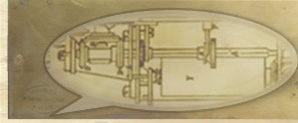
Detail of the T1822 mechanism


That does not make things easy!

The gear f is connected to a double arm lm that will cause its displacement and its return.

In its resting position, part a (wedge / helix) keeps a spring under tension by means of double arm lm that, in turn, will hold the gear f at a distance. a’ will pass by during the rotation.

A pin that is positioned on the axle with the spiral spring also blocks its projection. The pin is held back by a ratchet that will be freed by the action of a small wedge placed under the result register, when the register passes from 9 to 0. 

So when the pin ceases to hold back the double arm lm, the wheel f will be shifted by the spring to a position above the finger.

The tens-carry can take place !...

On completion of the rotation, part a will compress the spring by means of the double arm. The pin will be locked again by the ratchet that has moved back.


II) Sources


"Bulletin de la société d’encouragement de l’industrie nationale / M. Hoyau, 1822"


Extract :

« At the other end of the drum X are two small lever arms, one of which, Z, has a sharp end and the other one, a, ends with a small wedge. To the right and above the drum one sees a square axle b, which carries three gear wheels, two of which can move. Part c has a square hole through which the axle passes ; a small pulley d is mounted on this gear. The pulley is grabbed by a little yoke e, fig. 4, by which it can be moved to an appropriate point along the drum. The other gear f, of the same construction as the first, can only move over a small distance, enforced by the levers Z and a which are fixed on the axle of the drum X. The third gear is a conical wheel j with twenty teeth, immovably mounted at the end of the axle b.

A round shaft g is placed next to this axle. Its end h sticks in the upper plate and is held flush with the plate by a ratchet l’ that prevents the spiral spring i from pushing the end of the shaft outside the plate until it would be stopped by the edge k. The shaft g carries a yoke l that sticks into the pullet groove of gear f. The shaft also carries an arm m, which ends in a sloped edge. »

 [….]

 « If the first dial shows a 6 and one wants to add 7 to 6, one will shift the first pointer u to the position marked 7, which corresponds to the part of the drum X, where the number of grooves is such that it will turn the dial over seven divisions. If one pulls the band o’, the drum will turn once, and the dial should turn seven divisions and indicate 3 ; but the moment zero passes the window, the small wedge b’ of the first dial pushes away the first ratchet l’ , so the spiral spring i can push out the end of the first shaft g, because it is no longer held back by the ratchet, and the first gear f shifts into the plane of the small arm Z of the second drum ; when the second drum turns, the arm Z hits gear f and turns it over two teeth, that is, one division of the second dial. This dial, which indicated zero, will now indicate 1. Combined with the 3 of the first dial, this gives 13, the sum of 7 and 6.

This simple example shows how a tens-carry is performed. ».

 […] 

« Turning the attention to the way the drums X are grooved, one sees that only half of the circumference has ridges, and that the gears that engage with them will not turn during half a rotation of the drum. The tens-carries are performed during exactly that time. Just before the second half of the rotation is completed, the wedge a, which is mounted on the drum, has pushed the little shaft g in its normal position. So g has retracted its end h under the ratchet l’, which, pushed by the spring m’, has passed over the end of shaft g, and has taken a position where the gear or gears f can not be reached by the arms Z. »


www.arithmometre.org
2007