|
|||||||||||||||||||||||||||||||||||||||
| ◄ | |||||||||||||||||||||||||||||||||||||||
Carry-over system |
||||||||
Type 1 |
Type 2 |
Type3 |
Type 4 |
Type 5 |
Type 6 |
Type 7 |
Type 8 |
Type 9 |
* Translation by Andries de Man I) The machines from 1856 (T1856) and 1858 (T1858)
By 1856, Thomas constructed a new machine containing a more reliable tens-carry system. We have seen that Thomas had put a hook in the T1852 to prevent the carriage from being lifted inadvertently by the vertical push that the sloped edges exerted on the tens-carry levers. This hook blocked the vertical movement of the carriage during the rotation of the drums.
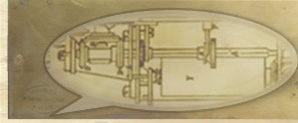
In the new machine the double wedge is replaced by a square steel block riveted on each dial, which, when passing from 0 to 9 or from 9 to 0, pushes, not vertically but horizontally, an intermediate part that is called the tens-carry hook
. All done!
The advantages are great ! First, the dial carriage can not be lifted by the horizontal push from the steel block. Secondly, the locking hook is obsolete so the operator can always lift the carriage if the machine is blocked!
The looks of the machine change slightly : The dial carriage has become wider, due to the fact that tens-carry hooks have shifted backwards compared to the position of the vertical-push levers of the T1852. The gear wheels of the dials are further away and the carriage has become wider. This layout gave room for the revolution counters to be placed there by 1858 ! The reversing mechanism (switch) is slightly raised compared to the 1852 machine. It is probably a direct consequence of the new tens-carry system: the shift backwards of the dials and the double sprocket wheels implies that the switch also has to shift a few centimetres. Thomas preferred to change the position of its notch rather than to redesign the components of the reversing mechanism! It is all a matter of economy ! |
www.arithmometre.org
2007