Carry-over system
                 
Type 1
Type 2
Type3
Type 4
Type 5
Type 6
Type 7
Type 8
Type 9
1820
1822
1849
1850-52
1856-58
1860
1865
1880
1887-1907

* Translation by Andries de Man

I) The arithmometer from 1865 (T1865)

The tens-carry mechanism described in patent N° 68923 from September 30, 1865 is still the benchmark for today!
All the machines made after that time, be they "Thomas de Colmar" models or Payen models, use this system. It is the result of many years of toiling!

In the 1865 machine the tens-carry mechanism consists of 20 parts. In 1880, the system was simplified to only 10 parts. Here are the details :

Detail of T1865 parts

   
1
Tens-carry hook
2
Tens-carry lever with square and mounting
3
Split stud for the lever
4
Pin
5
Screw
6
Yoke
7
One rod
8-9
Two springs
10
A tube for the springs
11
A screw
12
An iron brace with a square hole for the large axle
13
A steel wedge riveted to the plate
14
Geneva wheel mechanism
15
Its support
16
The tens-carry gear
17
A controlling drum
18
Its support
19
The spiral part at the bottom of said support, to let it go up wedge
20
A tens-carry finger


It is very similar to the system described for the 1860 machine!
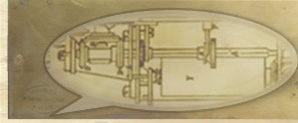
During the tens-carry phase, a square steel block that is mounted under the result dial pushes a small horizontal part b, called the « tens-carry hook ». This hook rocks a lever that pushes a tens-carry finger into a position where it can engage the gear T.


Detail of the T1865 mechanism


Detail of the T1865 mechanism


At the end of the tens-carry phase, a helically-shaped piece meets a steel butt a, that pushes the tens-carry finger back to its original place. This improved tens-carry mechanism is made even more reliable by the addition of double springs riveted on a support; this support itself is attached by a screw to the rod carrying the tens-carry yoke d.

T1865

T1865


II) Sources


Patent N° 68923 of September 30, 1865


« In the new machine the double wedge is replaced by a square steel block c (fig. 2 ), riveted on each dial, that, on passing from 0 to 9 or from 9 to 0, pushes back horizontally part b (fig. 3), called the tens-carry hook, instead of dropping it vertically. This makes the carriage locking hook obsolete because the carriage can not be lifted by the new tens-carry mechanism.

The tens-carry hook b (fig. 3), being displaced horizontally, lets the tens-carry finger S (fig. 4) drop by means of part A (fig. 4 and 8), called the tens-carry lever or yoke lever.

This yoke lever rocks by means of a pin that sticks through it and is mounted in a copper stud that is split to let the lever pass ; the stud is mounted on the frame by a screw e (fig. 3).

This tens-carry lever or yoke lever actuates the finger S by means of rod d (fig. 4), that receives the yoke of this lever in a groove; at the end of this rod, there is a steel yoke which enters the circular groove of the base of the controlling drum Q (fig. 4).

If rod d goes down it drops the controlling drum and thereby also its tens-carry finger S (fig. 4); if this finger turns it grabs a tooth of the tens-carry gear T (fig. 3), that is mounted on the base of a Geneva wheel. The helically shaped base of the controlling drum, continuing to turn with the square axle, meets a steel butt d (fig. 4), that forces the controlling drum and the tens-carry finger to take their original positions so the tens-carry finger passes between the tens-carry gear T and the Geneva wheel B (fig. 3), until the dial, passing from 0 to 9 or from 9 to 0, depending on the operation, will push out the tens-carry hook again and drop the tens-carry finger.

This new improvement in the tens-carry mechanism is made reliable by means of double springs riveted on a support; this support itself is attached by a screw to the rod carrying the tens-carry yoke d (fig. 4).

The frame A (fig. 4), on which one sees the above-mentioned springs folded at right angles, is countersunk in two parts with sharp angles. This way the spring will drop the tens-carry yoke entirely if the tens-carry takes places; similarly, as soon as it has ascended the sloped steel edge d (fig. 4), half-way, the spring will let it ascend completely. The double spring makes the tens-carry very reliable, because it can not be stuck halfway: it has to go down or up completely. »


www.arithmometre.org
2007