|
|||||||||||||||||||||||||||||||||||||||
| ◄ | |||||||||||||||||||||||||||||||||||||||
Carry-over system |
||||||||
Type 1 |
Type 2 |
Type3 |
Type 4 |
Type 5 |
Type 6 |
Type 7 |
Type 8 |
Type 9 |
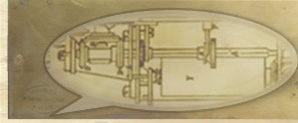
* Translation by Andries de Man I) The 1880 Arithmometer : a ghost patent..... ? Patent N° 138912 is still a mystery !!! It seems from the patent that Thomas (son) managed to reduce, without a doubt helped by Payen, the number of parts needed for the tens-carry. Only ten parts were necessary to build a complete mechanism. The cost reduction is far from being negligible since for an arithmometer with 20 digits, 110 parts will do, instead of 220.
« The tens-carry hook b that is extended by a bent and counter-bent rod, enters a circular notch in the end of the support of the Geneva wheel and acts as a lever. When the dial passes from 0 to 9 or from 9 to 0, depending on the operation, its cam (square block) will push back the tens-carry hook. Its lever-shaped extension moves the Geneva wheel, which has a support that can move along the square axle. The Geneva wheel will pass in front of the notch made for the 10th tooth on the controlling drum, which is fixed on the axle, as well as the tens-carry finger. During this movement, the tens-carry wheel is brought in front of the finger. The rod which extends the tens-carry hook and which is bent and counter-bent has a shaped end which can enter the circular groove of the Geneva wheel support. The cross-section of the counter-bent part is ^-shaped and forms two inclined planes which simply support a bent spring that is fixed by two screws to the back plate of the cage. This spring enforces the position of the Geneva wheel, at the top or bottom, depending on the tens-carry being made or not. When operating the machine, all tens carry levers that are dropped during the turn of the crank, stay down. To enable the tens carry levers to be used in a new cycle, the crank moves, on returning to its starting point, a round steel shaft by means of a release mechanism. The shaft passes in front of all Geneva wheels and is equipped with yokes that descend from the shaft between the Geneva wheel and the tens-carry gear. The release mechanism rocks the round shaft and its yokes, which put all Geneva wheels, that where moved by the tens-carry, back to their original position. »
We would like to see one working ...
In the 1880 patent, the tens-carry hooks are inverted and have their mountings at the right. It is possible that the system has been tested on some machines. It might be possible to find it in one or more of the machines with serial numbers from SN 1300 to SN 2400.
II) Sources
Extract ...
|
www.arithmometre.org
2007