* Translation by Michel Bardel, France
I) The reverser
Around 1844-1848, Thomas de Colmar develops the reverser. This clever system considerably simplifies the operation of its calculating machines.
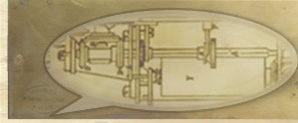
Under the carriage face plate, the following parts are concerned:
1) The bevel wheel of each dial (total) wheel
2) The double bevel wheels mounted on the square shafts
3) The sliding metal band.
"The subtraction and division being the reverse rules of the addition and multiplication, to perform these last operations I have fixed, on the square axes, two bevel wheels, having each of them ten teeth, which cause the dials to turn from right to left and from left to right. Between the two bevel wheels are set grooves having the same width than a metal band. I cause all the bevel wheels to recede or to advance together by means of the said band which passes in the grooves of the bevel wheels in order to have those of the front or back to cog with the wheels of the dials” (patent 13,504).
In short, this band will advance or recede, according to whether Addition or Subtraction mode is selected. In Addition mode, it is the former wheel which gears with the dial. In Subtraction mode, it is the posterior wheel.
Now, the way the metal band is actuated is the main topic of this page. We are going to see that Thomas changed it several times (rotate a nut, press a button or push a lever), until he found the most reliable one.
Before going into more details, it is good to understand the main interest of this reversing mechanism. It makes it possible for the cylinders to always turn in the same direction, which is vital in this type of machine: you have already noted that the report mechanism is not reversible!
Lever L, bevel wheels I, plate K |
|
| |
|
II) Reverser switches : types and positions
If the principle remains the same since 1848, the type and position of the switches evolved with time. In many instances, it is easy to date the machine, only by looking at the reverser switch!
A) The wing nut (1848-1850)
“I obtain this change from the multiplication to the division, or that from the addition to the subtraction, and vice versa, by turning the wing nut, and in that manner its indicator points out the real operation to be performed.” (patent 13,504 - 1851).
B) The lower horizontal switch (1852 -)
C) The higher horizontal switch (1856-1858)
D) The “Push-buttons” switch (1860 -)
E) The vertical switch (1865-1907)
|