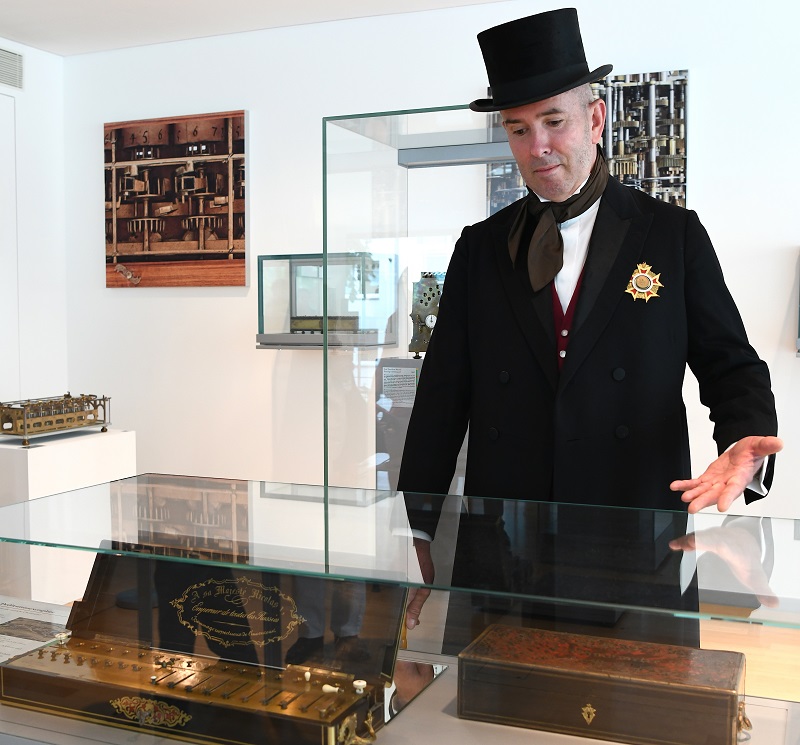
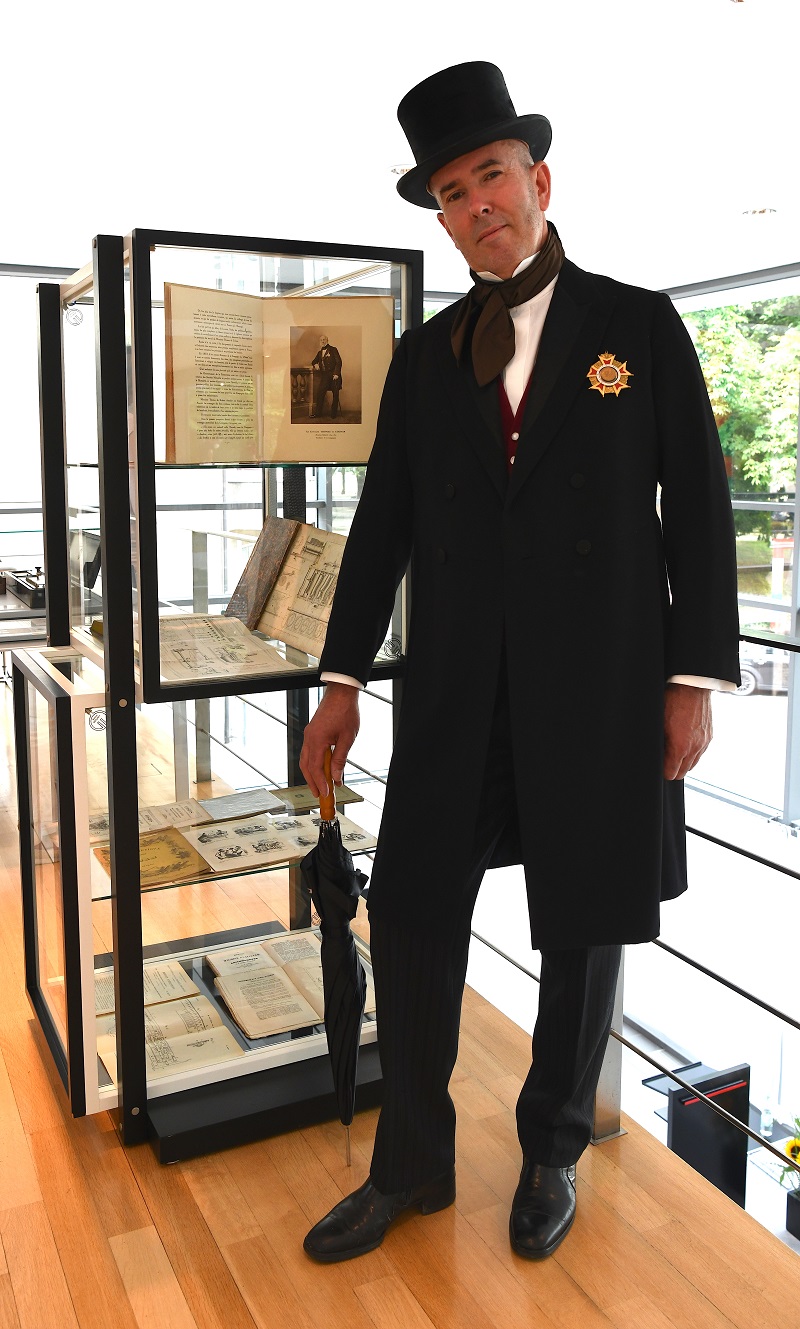
The Thomas de Colmar's arithmometer
   

*Translation by Eric Schurmann


/ Valéry Monnier
Conference of 30th  September, 2006 in Wasselonne.


In 2020, 14 years from now, perhaps we can all get together to celebrate the bicentenary of the first calculating machine commercialised in the world: Thomas de Colmar's arithmometer.


Two hundred years and what progress!

At the dawn of the 19th century we went from one revolution to another ( the Industrial Revolution).

The development of science and technology, commerce, banking and insurance, created important calculating needs.

Creating a machine capable of satisfying the merchant as well as the engineer, the industrialist as well as the scientist, is the challenge that Colmar took up!

Of course, others had tried before him: Schickard, Pascal, Leibniz, Moreland, Lépine, Hahn, Leupold, Stanhope are just
some of the inventors whose genius we should salute. But these machines, often defective and very expensive, made it impossible to commercialise.

In 1820, Thomas took out a patent on his first arithmometer1. A machine was built in 1822 by Devrine, a Parisian watchmaker.

The scientific community was enthusiastic; the Bulletin of the "Société d'Encouragement pour l'Industrie Nationale", under the pen of Francoeur and Hoyau, paid him homage.  The machine is perfectly described and represented therein.

And then!  And then!  Nothing more until 1844!! The date at which Thomas' arithmometer is mentioned at the National Exhibition in Paris.
Was the machine of 1822 too delicate to lay claim to a glorious destiny ? Or was Thomas so absorbed by his work that he forgot his first loves?
However that may be, the middle of the 19th century marked the real beginning of the "technico-commercial" adventure of the arithmometer.


We know that, from about 1844, Piolaine, the son of the famous watchmaker of Neuilly, was working on the construction of a new machine, bigger and more reliable than its ancestor of 1822.

Perfecting this machine seems to have been difficult but finally, in July 1848, it left the workshop!

Several of you know this superb machine which was sold at Christie's in 1996 for a little over €150,000.

The patent for this machine was not taken out until one year later, in 1849 !

Discovered recently one can say, without fear of contradiction, that it is more than a patent!

First of all it's the testimony of an impassioned man.  He talks of his relations with Piolaine, whom he even went to see in England at his own expense in order that the latter should finalise the machine. 

And he describes mad projects for arithmometers without 'stepped tooth cylinders' and without cursors, as well as completely simple, small adding machines.

It also has the stamp of somebody sensing the arrival of the competition !  I'm thinking particularly of the machine by Maurel and Jayet4, capable of direct multiplication and which was a sensation at the Academy of Sciences in 1849.  I am also thinking of the machine by the Pole, Staffel, which won a medal at the Universal Exhibition in London in 1851.

What would have happened to the arithmometer if the amounts spent to perfect the arithmaurel had been of the same order as those spent by Thomas ? ....

Because, if it was his passion, his immense fortune allowed him to indulge it ! In order to promote his machine, he didn't hesitate to offer the crowned heads of Europe sumptuous machines in richly decorated cases.


At the Universal Exhibition in 1855, he presented a gigantic machine, with 30 digits, resembling a piano ! This machine was so impressive that even Jules Vernes mentioned it in one of his visionary novels written in 1863 "Paris in the 20th Century".

I quote : "…To begin your apprenticeship you will work on machine number four. Michael turned and saw machine number four. It was a calculating machine.  It had been a long time since Pascal built such a machine whose conception seemed so amazing then.  Since then, the architect Stanhope, Thomas de Colmar, Maurel and Jayet had introduced useful modifications to this type of machine.  Casmondage owned some true masterpieces; the machines resembled enormous pianos; on pressing the keys, one immediately obtained totals, remainders, products or quotients…..it was evident, he was joining a bank which required, and adopted, all possible mechanical help.  Besides, at this time, the volume of business and the quantity of correspondence, gave an extraordinary importance to ordinary office equipment."

The first serial numbers began to appear and the first instruction manuals; signs heralding a commercialisation phase


The machine had become really reliable and the costs of construction had been brought under control.


This was important because who would want to pay €10,000 for a machine which gave inexact results or which broke after the hundredth time it was used ?

Among the technical improvements worthy of mention, were:

   In about 1852, the addition of a device in the shape of a Maltese cross to prevent inopportune overruns caused by the inertia of the moving parts.


  The introduction, from 1858, of a counter with windows showing the number of turns made by the crank (multiplier or quotient).

   The improvement of clearing devices, with a spring mechanism.


A carryover mechanism offering absolute reliability.

 Ah ! The carryover mechanism; the pet hate of our inventors.

Trying to shift this wretched unit to the next order of decimals has cost enormous effort and, above all, huge amounts of money! When one realises, for example, that Leibniz spent 10,000 florins to build a defective machine, one is left speechless!


The Thomas arithmometer was not immune to these difficulties and it was not until the years 1850-1860 that a really reliable system was finally put in place.  Moreover the mechanism described in the 1865 patent remained the reference for nearly 50 more years !


The "Thomas theorem"


To resume Thomas' principle of the carryover and its evolution here is a theorem which he could well have written.


"A, acting on B, is going, by thrust, escapement or translation, to displace C,

which will engage with D and transmit one unit to the next higher order of decimals. 

At the end of the cycle, X allows C to return to its initial position ".


The explanation:

The piece A is placed under the totaliser; this can be an impulse pin or a steel cam, for example. At the passage of the 10th unit, it will act on a shaft or a lever and displace a wheel or a tooth.  This wheel or this tooth will engage momentarily with a pinion, long enough to transmit one unit to the next order of decimals, i.e. the counter to the left.  At the end of the cycle, all the elements return to their initial state. 


How to use the Arithmometer !

The apparatus consists of a fixed part and a moving part.  On the cover of the fixed plate, a series of buttons (cursors) move along a scale (0 to 9).  They are used to inscribe the figure of the multiplicand and move the pinions engaging with the stepped tooth cylinders (under the cover).  Once the multiplicand has been entered, one turns the crank and the value of the multiplicand is added to the totaliser.  By moving the carriage one or two places it is thus possible, by a turn of the crank, to multiply by 10 or 100 the value of the multiplicand. 

If, for example, one wishes to  multiply 547 by 97. Instead of turning the crank 97 times, here is what one does:

after having entered the multiplicand 547, one moves the carriage two places to the right then one turns the crank once; the value of 54,700 appears on the totaliser.  i.e. 547 multiplied by 100.  It only remains to return to the initial position and use the direction inverter to make a subtraction, and to turn the crank three times. One will thus obtain the result 53,059 in four turns of the crank.

OK !  That is a simple example …


Back to business …

When Thomas died, in 1870, more than 500 arithmometers had left the workshops at 13 Rue du Helder and, later, 44 rue de Chateaudun, in Paris. 
His son, Thomas de Bojano, continued manufacturing for several more years under the management of a talented engineering constructor : Payen !

New workshops at 16 rue de la Tour des Dames, in Paris, and new machines served to make production profitable.  Output rose to over 100 machines per year ! 

Of 100 machines, 30 were six-digit, 60 eight-digit and 10 twenty-digit.

More than half were exported !

In France, as in other countries, the principal users were the administration, insurance companies, banks and laboratories!  

A trained operator could multiply a 16 digit number by an eight digit number in less than 30 seconds and calculate a square root of 16 digits in just over one minute!

But this turn-of-the-century began to be difficult for the arithmometer - henceforward, the Payen - because new machines were arriving on the market.


On the one hand, as from 1880, there was a flurry of foreign arithmometers: Burkhardt, Layton, Saxonia, Bunzel and many others !


Since probably no patent was registered in Germany or in Austria, and the English patent of 1851 having expired, one can imagine that foreign manufacturers jumped into the legal breach ! In short, the arithmometer had entered the public domain !

Unless!  Unless!  Thomas de Bojano (or his heirs) had sold utilisation licences….  but, so far, we have no information on this subject !!

   
On the other hand, the market was progressively diversifying: machines built with the Odhner system, machines with touch keys (Felt and Tarrant), and the direct multiplying machines such as Steiger's Millionaire, also had their day of glory.

Payen would now have to share the cake with his competitors.

Nevertheless, the arithmometer remained a valuable asset as the wealth of prizes at universal exhibitions attested :

Gold medals in Paris in 1889 and in 1900, for example, are not nothing!

At Payen's death, around 1902, his wife, Léontine, took up the torch and even registered a patent in 1907.  This last model, with slide-knobs, would be built by Darass up to the years 1914-18 before disappearing, a victim of the competition. 


But
, let's go back a hundred years to the sources of the invention.

From 1809 to 1813, Thomas managed the supply of victuals for the French armies operating in Spain and Portugal.  In 1814, he was promoted to Rations Inspector for the French army! Confronted by a rigorous, long and difficult administration, one can imagine that Thomas had the idea, rather like Pascal, of inventing a machine capable of relieving man of his administrative tasks.  This became even more important in his eyes when, in 1819, he founded the Phoenix insurance company and, later, the companies Soleil (Sun) and Aigle (Eagle). 
 

* A little anecdote : do you know why Thomas de Colmar gave the name Eagle to his insurance company?

 No ?

 « Only the Eagle can hide the Sun ...  »

In short, his idea followed its course because, in 1820, a patent was registered.


Maurice d'Occagne wrote:

"in putting to work, in a new format, certain mechanisms known from the past, combined with new ones, he managed to create a machine which, from a practical point of view, was excellent and which nobody before him had succeeded in doing."


One has often wondered whether Thomas knew about Leibniz's machine whose three major elements he uses:

- The stepped drum cylinder
- The multiplying wheel
- The double numbering

We will not enter into the debate here !

A deep study of the 1820 patent has enabled us, with Michel Bardel, to bring to light a certain number of inconsistencies. We have quickly demonstrated that a machine built following this patent blindly could not function.  A certain number of questions follow :

     Did Thomas deliberately introduce errors in his patent in order to mislead any possible competition ?

    Were these errors the fault of the writer or of the draughtsman of the patent ?

    Did Thomas make errors of conception ?

It is in order to try to reply to these questions that we have undertaken to make some corrections to the 1820 patent.

Without changing the spirit of the machine, we have found some modifications, as unintrusive as possible, which suffice to make it viable! 


The purpose of the project "Arithmometer 1820" is the modeling and the construction of the machine designed by Thomas de Colmar, in his first patent of 1820.

Too often confused with the 1822 model, of which an example is housed in the Smithsonian Institute in Washington, the moment has come to restore it to its deserved place of honour !

Technically, they are so different !

Without wishing to enter into the debate here, the 1822 model, very advanced in relation to the initial patent, was considered as a second-generation model, of which the Bulletin of the "Société d'Encouragement", of November 1822, gave the detailed specifications.

Was the 1820 machine ever built ?

There are two hypotheses :

  The machine never saw the light of day because the plans show numerous inconsistencies which make the machine unbuildable.

  a primitive machine was built !


The report made by Mr Francoeur, in February 1822, leans towards this.

I quote :

« He (Thomas) has even tried and abandoned several mechanisms which not did not fulfil their role before choosing the one  for which he requests the vote of the Société d'Encouragement ».

One can also ask :

if Thomas never built the primitive machine, where did the plans come from?  Was it from his imagination that he designed a multiplying wheel and conceived a carryover system, certainly not perfect, but innovative!  And which was the precursor of the carryover system of his future arithmometers ?

I tend to believe it.  

But we will probably never know any more ! 

However !

Our enthusiasm has become a mission : to give life to this phantom machine !


It is a project with several objectives:

 1.  Validate the original ideas of the 1820 patent.
By giving life to a machine when we do not know if it ever existed, we validate the principles and the architecture chosen by Thomas.  In building it, we bring to light the obscure points in the patent.

2.  To understand exactly where Thomas really was in his reflections and his knowledge at the time that he drafted his patent.
We don't know what is the result of ignorance, of transcription errors, of insufficient thought or of dissimulation. 

3.  To imagine what were the stages of construction of the arithmometer and to understand why the design changed.

4.  To use computer modelling so as not to have to build a prototype which would not work.
This stage of computer aided construction is absolutely necessary to reduce the costs of the project.

 5.  To understand the state of mechanics in 1820 and the means available for machining and construction.
We have access to a prototype of 1850 and to a machine of 1852. It would be interesting to examine in detail the tools used to make them.
Our project could also be the occasion to gain access to the prototype of 1822 which is jealously guarded by the Smithsonian Institute in Washington !

 6.  To build a functioning machine.
The realisation of a functioning prototype should enthuse many people.  Its reproduction in multiple copies could constitute an objective in itself.  We know that collectors and museums are keen on good functional replicas of the models which have disappeared.


In conclusion, this project is of interest to :

  • historians of science and technology;
  • insurance historians;
  • mechanics students;
  • students of mechanical conception, modelling and computer aided construction;
  • students of technology, machining and assembling;
  • museum curators;
  • collectors;
  • the curious and lovers of beautiful objects from the past;
  • mechanics, programme editors, professors, who could join their names to this realisation;
  • France, Alsace, the town of Colmar, Paris, Thomas' descendants, the friends of the arithmometer who will all see in this project the validation of a story and a heritage dear to their hearts;
  • all the others.


It remains a rough road !

Here, in a few points, is what remains to be done.


A)    3-D modelling

Nowadays, one rarely builds a machine without having previously tested its proper functioning in a virtual environment.  For reasons of cost, on the one hand, it would be folly to build a prototype which doesn't work! For technical reasons, on the other hand, because it is likely that minor modifications will be necessary. Using a powerful computer tool allows the mechanisms to be adjusted without re-drawing the plans.

Powerful programmes such as Solidworks, Catia, Pro/Engineer, exist in the market.

The project is progressing on this point.  Mark Glusker, of San Carlos, California, is helping us.  He is a mechanical engineer and has worked for 12 years on Pro/Engineer. He is known for having modelled and built the Thomas Fowler machine of 1841.
So he is a valuable asset!


       B) Project Support

In order to support the project of modeling and building the arithmometer, we are going to create an association: "The Friends of the Arithmometer".  The project will evolve under its guiding light and its members will be able to participate in the project by bringing moral support, technical or financial help.


C)    Recherche de partenariat

Search for Partnerships. The construction of the machine inevitably implies a search for partnerships.  It consists, on the one hand, of the design and modelling of the machine and, on the other hand, of financing its construction.


       D) Construction and Commercialisation.

In order to reduce the costs of construction, we could consider making several copies since museums and collectors could well wish to have one.


Here's to our success !!!!


www.arithmometre.org
2007