|
|||||||||||||||||||||||||||||||||||||||
| ◄ | |||||||||||||||||||||||||||||||||||||||
Carry-over system |
||||||||
Type 1 |
Type 2 |
Type3 |
Type 4 |
Type 5 |
Type 6 |
Type 7 |
Type 8 |
Type 9 |
* Translation by Andries de Man I) Arithmometer from 1850 (T1850) and 1852 (T1852)
« In the old machines, the tens-carry was made by means of a steel double wedge, mounted on the dial, that pushed the tens-carry lever and released it and lowered it vertically; but it turned out that, when several wedges on the dials pushed their tens-carry levers at the same time, and if the levers did not go down easily, they would lift the dial plate instead, which weakened the engagement of the bevel gears with the dials, giving wrong results in the dials.
III) Remarks The patent from 1865 shows why Thomas had to modify his tens-carry mechanism since 1856. It is true that since 1822, the wedges mounted under the result dials pressed almost vertically on the levers and sometimes lifted the carriage, producing wrong results!
IV) Sources
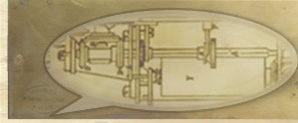
Extract : « All the drums Y, Y, Y, etc.(fig. 4, 5, 6, 7, 8 and 12) of the multiplicand, including multiplicator drum H, have a 24 teeth bevel gear at one of their ends. All these gears engage similar bevels gears fixed on one single shaft O O O (fig. 4, 5, 6 and 8). At the right end of this shaft a bevel gear is mounted that engages the bevel gear of the crank handle shaft N (fig. 4, 6 and 8). At the other end of the drums Y, Y, Y, etc. and H (fig. 4), is a system for performing tens-carries. The movable teeth or fingers K, K, K, etc. (fig. 4, 5, 6, 7, 8 and 12), do not engage the ten-tooth gears Z, Z (fig. 7) , until they are required to perform the tens-carry. To enable this, the spiral springs, placed between the fingers K, K and the drums, as can be seen in fig. 12, push these fingers so that they can meet, during their rotation, the tens-carry gears Z, Z., etc., that are fixed by springs (fig. 7). This can not happen unless the dials have passed from 0 to 9 or from 9 to 0 ; because then the small double wedges U, U (fig. 3 and 6), pressing the levers L (fig. 9), allow the spiral springs to push out the fingers K, K (fig. 4, 5, 6, 7, 8 and 12), which was not possible when they were retained by the small pin l of lever L ( fig. 9). If the spiral springs are relaxed and the little fingers K, K stick out, turning the drums by means of the crank N will cause the small fingers K, K, etc. to meet the tens-carry gears Z, Z, Z, etc., and turn them over one tooth. This will turn the result dials over one digit. During the rest of their rotation, the small fingers K,K, etc., will meet the little wedges t (fig. 4, 5, 6, 7 and 10), mounted on the frame (fig. 7), that let them return to their initial place, after which they are kept at that position by the pin l of the lever L (fig.9). If now one rotates the drums, with the fingers back at that position, the fingers will pass in front of the tens-carry gears Z, Z, Z, etc.(fig. 7), without turning them around. It is now time to explain why eleven teeth of the drums Y, Y, Y are completely cut away (fig. 4 and 8). To perform the tens-carries, each drum should receive its carry after having produced its own number. This can only take place if the tens-carries are performed sequentially, the one after the other. It is therefore necessary that those for the tens are produced before the hundreds, those for the hundreds before the thousands etcetera. That's why the drums Y, Y, Y (fig. 4) are so placed that they engage the multiplicand gears A, A, A, etc. one after the other: so the drums Y, Y, Y, etc., and their fingers K, K, etc., should be placed relatively to each other as shown in fig. 4 and 7. » |
www.arithmometre.org
2007